
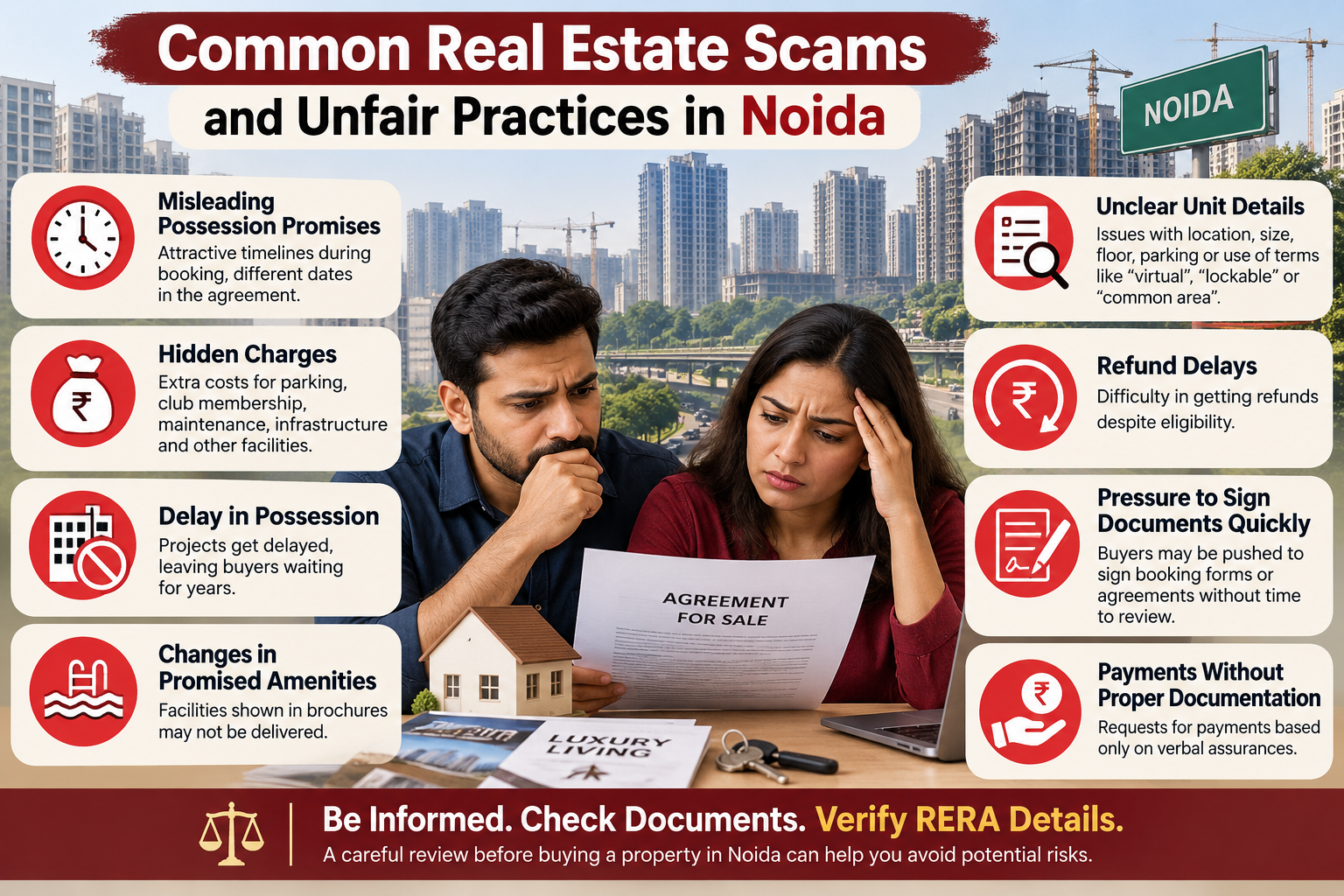
Common Real Estate Scams and Unfair Practices in Noida
Buying a property in Noida is a major financial decision. While many developers operate legitimate projects, homebuyers can sometimes face misleading promises, hidden charges, delayed possession, or documentation issues.
Here are some common practices that homebuyers should carefully check before buying a property.
1. Misleading Promises About Possession
A buyer may be given an attractive possession timeline during booking, while the contractual possession date may be different.
Always check the Agreement for Sale and the UP RERA registration details instead of relying only on verbal assurances.
2. Hidden Charges
Some buyers discover additional charges for parking, club membership, maintenance, power backup, infrastructure, or other facilities later in the transaction.
Before making payment, ask for a complete written statement of all applicable charges.
3. Delay in Possession
One of the most common complaints in real estate is delay in handing over possession.
If possession is substantially delayed, the buyer should examine the Agreement for Sale, RERA records, payment history and applicable provisions of the RERA Act before deciding whether to seek possession, interest, refund or another remedy.
4. Changes in Promised Amenities
Brochures and sales presentations may show facilities such as clubhouses, parks, swimming pools, commercial areas or other amenities.
Buyers should compare these promises with the registered project details and contractual documents.
5. Unclear or Misleading Unit Details
Before purchasing a unit, carefully verify its location, size, floor, tower, parking allocation and other details.
Particular care should be taken where the documentation uses terms such as “virtual,” “lockable,” “common area,” “commercial unit,” or “assured return.”
6. Refund Delays
In certain disputes, buyers may become entitled to seek a refund depending on the facts and applicable law. Problems can arise when the developer delays payment or disputes the buyer’s entitlement.
The buyer should maintain all payment records and written communications.
7. Pressure to Sign Documents Quickly
Buyers may sometimes be encouraged to sign booking forms, allotment letters or agreements without sufficient time to read them.
A property document should never be signed merely because a salesperson says that the offer will expire immediately.
8. Paying Without Proper Documentation
Payments should be made through traceable banking channels and supported by proper receipts and documentation.
Buyers should be cautious about making substantial payments based only on verbal assurances.
How Can Homebuyers Protect Themselves?
Before purchasing a property in Noida, check:
-
UP RERA registration
-
Promoter details
-
Project completion/possession timeline
-
Agreement for Sale
-
Approved project details
-
Payment schedule
-
All additional charges
-
Unit and carpet-area details
-
Refund and cancellation clauses
-
Previous correspondence and commitments
If a dispute has already arisen, the buyer should preserve the complete documentation and obtain legal advice before taking further action.
Conclusion
Not every delay or disagreement with a developer amounts to a “scam.” The legal position depends on the documents, contractual promises, project status and applicable law.
A careful review of the property documents before making a major payment can help homebuyers identify potential problems early and understand their available legal remedies under RERA.


This Post Has One Comment
Hi, this is a comment.
To get started with moderating, editing, and deleting comments, please visit the Comments screen in the dashboard.
Commenter avatars come from Gravatar.